On this page
Choosing the right auto insurance in Waterbury means understanding what Connecticut law actually requires, what your lender may demand on top of that, and how your vehicle’s age, value, and daily use shape the coverage you need. This guide breaks down each layer so you can make confident decisions about your auto insurance policy without overpaying or leaving gaps that cost you later.
Key Takeaways
-
Connecticut requires minimum liability limits of 25/50/25 (or a $50,000 combined single limit) plus uninsured/underinsured motorist coverage of at least 25/50. Collision and comprehensive are optional by law but typically required by lenders on financed or leased vehicles.
-
A financed car and an older paid-off car call for different insurance strategies. Auto insurance needs depend on vehicle value and driver factors like commuting distance, garaging location, and household members with access to the vehicle.
-
“Full coverage” is an informal term, not a legal one. It usually means liability, UM/UIM, collision, and comprehensive – but it still excludes mechanical breakdowns, routine maintenance, and commercial use unless specifically endorsed.
-
Driving conditions in Waterbury can affect insurance requirements. Daily commuting on I-84 or Route 8, on-street parking, and New England weather all influence the coverage options that make sense for your situation.
-
Request nonbinding quotes at connecticutautoinsurance.com/quote/ or call Drivers Insurance Agency, Inc. at (844) 399-1313 to compare participating insurers using the same limits and deductibles.
Waterbury, CT Auto Insurance Overview
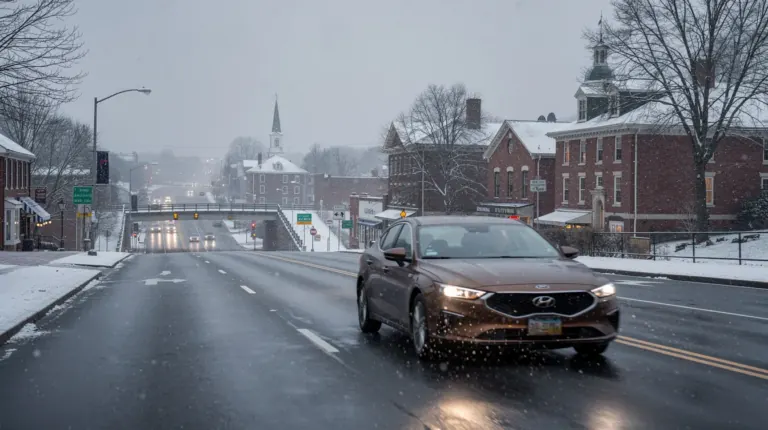
Waterbury sits in New Haven County at the intersection of I-84 and Route 8, with the MixMaster interchange carrying regional commuters. On-street parking and winter weather add exposure to collisions, theft and weather damage. Your rate depends on your vehicle, driving record, household, garaging location and coverage choices.
This article is a Waterbury-focused personal auto insurance guide from ConnecticutAutoInsurance.com, operated by Drivers Insurance Agency, Inc., phone (844) 399-1313.
-
We help compare policies from participating insurers. Quotes are nonbinding until the insurer approves and sets an effective date.
-
Carrier participation and availability can change. We do not guarantee savings or acceptance.
-
While Waterbury drivers may recognize large brands like State Farm from advertising, this guide focuses on how coverage decisions work for you – not on promoting any competing agency or insurer.
-
The sections below connect Waterbury daily driving conditions to the coverage choices that matter most for local households.
Connecticut Auto Insurance Requirements vs. Lender Rules
Connecticut law sets the floor for what every registered vehicle must carry. Here is what the Connecticut Insurance Department requires:
-
Bodily injury liability: $25,000 per person / $50,000 per accident. Connecticut requires minimum liability coverage of $25,000 per person.
-
Property damage liability: The minimum liability coverage for property damage is $25,000.
-
Uninsured/underinsured motorist (UM/UIM): Connecticut mandates uninsured motorist coverage of $25,000 per person / $50,000 per accident.
-
An alternative combined single limit of $50,000 is also allowed.
In plain terms, the 25/50/25 split means if you cause an accident injuring two people, your policy would pay up to $25,000 per person but no more than $50,000 total for bodily injury, plus up to $25,000 for the other driver’s property damage. Consider a multi-vehicle fender-bender near Brass Mill Center where two cars sustain moderate body damage and one driver needs an ambulance – repair and medical bills can exceed $25,000 quickly. Drivers can opt for higher liability limits for better protection. You can learn more about minimum car insurance requirements on our dedicated page.
What lenders add on top:
-
Collision and comprehensive are not mandated by Connecticut law, but banks, credit unions, and finance companies almost always require them on financed or leased vehicles.
-
Lenders typically cap deductibles (often $500 or $1,000) and require you to list the lender as loss payee.
-
If you fail to maintain the required coverage, the lender can purchase force-placed insurance on your behalf – usually more expensive and designed to protect the lender’s interest, not yours.
Financed Vehicles vs. Older Paid-Off Cars in Waterbury
Insurance strategy looks different for a newer financed SUV parked near the Waterbury Green versus an older paid-off sedan used for light local errands around the Mattatuck Museum area or Town Plot.
Financed cars:
-
Most lenders require collision and comprehensive in addition to liability coverage. Check your specific loan or lease agreement.
-
If your loan balance exceeds the vehicle’s actual cash value, the gap can leave you owing money after a total loss. Gap insurance addresses this, and some lenders require it.
-
Moderate deductibles ($500) keep out-of-pocket costs predictable when a claim happens.
Older paid-off vehicles:
-
When a car’s market value drops below $3,000–$5,000, paying collision premiums may cost more over time than what a payout would return. Basic packages keep premiums low for some drivers who accept the trade-off.
-
Some Waterbury drivers keep comprehensive even after dropping collision – it covers theft, vandalism, fire, and storm damage, which matters when you park on the street overnight.
-
If replacing the car out-of-pocket would create real financial hardship, keeping at least some physical damage coverage makes sense regardless of vehicle age.
We help drivers at ConnecticutAutoInsurance.com run “what if” scenarios: what changes in your quote when you move from full coverage to liability-only on a second, older vehicle?
Collision and Comprehensive: Deductibles, Vehicle Value, and Out-of-Pocket Risk
These two coverages protect your own vehicle, but they work differently:
-
Collision pays for damage when your car hits another vehicle or object – a rear-end on I-84, a guardrail on Route 8, or a parking lot scrape.
-
Comprehensive protects against non-collision events: fire, theft, vandalism, falling branches, glass damage, and animal strikes. A comprehensive policy protects against major expenses from accidents and animal collisions that are otherwise entirely out-of-pocket.
Deductible math:
Raising comprehensive and collision deductibles can lower your monthly premium significantly. But the trade-off is real. Consider a $1,200 bumper repair after a low-speed collision:
|
Deductible |
You pay |
Insurer pays |
|---|---|---|
|
$500 |
$500 |
$700 |
|
$1,000 |
$1,000 |
$200 |
Newer Waterbury vehicles with higher values may justify lower deductibles because the potential claim payout is large relative to premium cost. Older cars with modest value might reasonably carry higher deductibles – or no physical damage coverage at all.
Some Waterbury residents park on city streets, in shared lots, or near trees. That exposure to vandalism, theft, or storm damage can make comprehensive coverage more valuable than it might seem on paper. Our role is to help you find a comfortable balance between keeping premiums manageable and limiting surprise bills.
What “Full Coverage” Usually Means in Waterbury CT
“Full coverage” is a phrase Waterbury drivers use constantly, but it is not a legal or policy term. It usually means liability, UM/UIM, collision, and comprehensive on the same car – but the details underneath vary widely.
What it typically includes:
-
Bodily injury and property damage liability at your chosen limits
-
UM/UIM coverage
-
Collision and comprehensive with your chosen deductibles
-
Possibly rental reimbursement, roadside assistance, or medical payments depending on insurer and endorsements
What it often does not cover:
-
Routine maintenance, oil changes, tire wear, brake pads
-
Mechanical breakdown (a blown transmission on I-84 is not a covered loss)
-
Using your car for ride-share, delivery, or other commercial purposes unless specifically endorsed
-
Custom parts or aftermarket upgrades unless declared on the policy
-
Wear and tear or gradual deterioration
Two Waterbury drivers can both say they have “full coverage” and carry very different limits, deductibles, and optional protections. Review your declarations page rather than relying on the phrase. Our team can walk you through what each listed coverage actually does.
Drivers, Households, Mileage, Garaging, and Occasional Use
Personal auto insurance in Waterbury CT is priced not just on the car but on who drives it, where it is kept, and how it is used. Many factors determine the rate you see on a quote.
-
Household drivers: Insurers typically expect all licensed household members with regular access to insured vehicles to be listed. If a Waterbury teen gets a new license and starts sharing the family car, they generally need to be added to the policy.
-
Garaging address: Where your vehicle is kept overnight matters. A car garaged in Bunker Hill may be rated differently than one parked on-street near downtown. Insurance companies in Connecticut may utilize credit scores to determine auto insurance rates, and your ZIP code feeds into territory rating as well.
-
Commuting vs. pleasure use: Daily commuting on I-84 or Route 8 to jobs in New Haven or Hartford is treated differently than low-mileage local driving around neighborhoods like East Mountain or Brooklyn. Accurate annual mileage estimates protect you when a claim occurs.
-
Occasional borrowing: A non-owner policy may provide liability coverage for someone who does not own a vehicle and only occasionally borrows or rents. Regular access to a household or other vehicle can affect eligibility; ask the insurer before relying on this coverage.
Truthful answers on the application are not optional niceties – they are what keep your claim from being denied. We assist clients in clarifying grey-area uses before they become problems.
Continuous Coverage, Registration, and Connecticut DMV Rules
Connecticut law requires continuous liability insurance on any registered vehicle. The DMV Insurance Compliance Unit monitors this actively.
-
If your coverage lapses while the vehicle is still registered, the DMV sends a warning notice. A $200 civil penalty typically applies, and your registration can be suspended if the issue is not resolved.
-
Follow the instructions on your DMV notice. If you maintained coverage, provide the required proof for the dates in question; if coverage lapsed, follow the DMV’s requirements for resolving the lapse and any fine.
-
Processing can take up to 10 days once documentation is submitted.
Practical tips for Waterbury drivers:
-
Before changing coverage for a stored vehicle, follow current DMV registration and seasonal-storage requirements and check your lender’s requirements.
-
When switching insurers through ConnecticutAutoInsurance.com, make sure the new policy’s effective date aligns with the old policy’s end date – even a one-day gap can trigger a compliance notice.
-
For DMV location and appointment information, check the DMV website directly; do not rely on hours or fees listed elsewhere.
Handling Accidents, Claims, and Local Waterbury Resources
After a crash in Waterbury, the first steps are straightforward:
-
Move to safety if possible. Call 911 in any emergency involving injuries, fire, or entrapment.
-
Exchange insurance and contact information with other involved drivers.
-
Document the scene – photos of damage, positions of vehicles, road conditions.
-
Contact your insurer or agent to start the claim process.
Serious collisions or entrapments may involve the Waterbury Fire Department, which provides accident extrication, emergency medical response, and hazardous materials mitigation across its nine engine companies and three ladder companies.
To request a police report for an accident investigated by Waterbury Police, use the Records Division’s online portal. The Records Division is open Monday through Friday; check the portal for current details.
Keep all documentation – police case number, claim number, towing receipts, photos – organized. This speeds up the process regardless of which insurer handles your claim.

Hypothetical Coverage Comparison: Two Waterbury Drivers
This is a hypothetical example illustrating coverage choices, not a quote or price guarantee. No premium figures are included.
Scenario A – Financed late-model sedan, daily commuter:
-
Vehicle garaged in Waterbury CT, financed through a credit union
-
Daily I-84 commute to a Hartford-area employer
-
Carries liability at 50/100/50 (above state minimums), UM/UIM matching at 50/100
-
Collision and comprehensive with $500 deductibles to keep out-of-pocket costs predictable for a family budget
-
Rental reimbursement endorsement added
Scenario B – Older paid-off compact, local errand use:
-
Vehicle parked on-street in Waterbury, owned outright
-
Used for short errands and part-time work; low annual mileage
-
Carries liability at 25/50/25 (state minimum) with UM/UIM at 25/50
-
Dropped collision (vehicle value is modest)
-
Keeps comprehensive with $1,000 deductible for theft, fire, and vandalism protection
-
Accepts the risk of replacing the car out-of-pocket after a collision total loss; a covered comprehensive total loss remains subject to that coverage’s terms and deductible.
Both drivers can request same-limits quotes through our online form to compare participating insurers’ offers. The teaching point: the right combination of limits, deductibles, and included coverages depends on your car’s value, your financial cushion, and how you actually use the vehicle – not on a one-size-fits-all package.
How to Compare Waterbury Auto Insurance Quotes the Right Way
Comparing car insurance only by price can lead you to overlook critical differences. Comparing auto insurance quotes online is essential for securing affordable rates in Waterbury, Connecticut – but only if you compare apples to apples.
Same-limits quote checklist:
-
Keep liability and UM/UIM limits identical across all quotes
-
Match collision and comprehensive deductibles
-
Confirm whether towing, rental reimbursement, and roadside assistance are included or extra
-
It’s important to use identical coverage limits when comparing auto insurance quotes to get accurate estimates
Before you quote, gather:
-
VINs or year/make/model for each vehicle
-
Current odometer readings and estimated annual mileage per car
-
Driver license numbers for all household drivers
-
Tickets and accidents from the last 3–5 years
Our online quote form at connecticutautoinsurance.com/quote/ lets Waterbury drivers submit this information once. Final rates and acceptance always depend on insurer review. Liability insurance limits can be increased for better protection – the Connecticut Insurance Department notes that statutory minimums may be insufficient for many drivers.
Special Situations: SR-22, Non-Owner Policies, and Neighboring Cities
Some Waterbury drivers have needs outside a standard policy.
-
SR-22 filings: An SR-22 is a financial responsibility filing, not a type of insurance. Requirements come from the Connecticut DMV, a court, or another state. Not every DUI or violation triggers an SR-22; follow the exact instructions on your notice. See our SR-22 insurance page for more detail.
-
Non-owner auto insurance: Waterbury residents who do not own a car and occasionally rent or borrow may qualify for liability coverage. Regular access to a household vehicle can affect eligibility.
-
Nearby cities: The coverage principles here broadly apply to neighboring markets like Bristol, Meriden, and Torrington, though garaging ZIP code and local factors still affect underwriting and premiums.
Saving on Car Insurance in Waterbury Without Cutting Crucial Protection
Affordable auto insurance does not mean stripping away the coverage you actually need. For broader strategies, visit our cheap car insurance page.
-
Bundling auto insurance with homeowners or renters insurance may yield a discount. Compare the combined cost and coverage; savings vary by insurer and household.
-
Enrolling in safe driver programs can provide discounts on auto insurance premiums – ask whether participating insurers offer usage-based or telematics options.
-
Choosing deductibles thoughtfully (not just the lowest available) can save money without leaving you exposed.
-
Annual policy reviews and re-shopping can help maintain competitive auto insurance rates, especially after life changes like a new commute, a teen driver joining the household, or paying off a car loan.
-
Do not drop liability or UM/UIM below what you truly need just to save money. Even moderate property damage from a collision in Waterbury can exceed the $25,000 minimum quickly, leaving you personally responsible for the balance.
ConnecticutAutoInsurance.com helps Waterbury CT customers right-size their protection and find savings inside coverage that still keeps them on solid ground. We offer affordable coverage options at just the right price for your situation.
How ConnecticutAutoInsurance.com Helps Waterbury Drivers
Drivers Insurance Agency, Inc. operates ConnecticutAutoInsurance.com as an independent agency helping Waterbury CT residents compare personal auto coverage from participating insurers.
-
We are not a branch office of any particular insurer. We do not guarantee savings, acceptance, or specific outcomes.
-
Local agents can help find the best coverage for your situation – we walk through state requirements vs. lender rules, review current policies for gaps, and answer questions about household drivers, commuting, and occasional borrowing.
-
Quotes are nonbinding until an insurer completes underwriting and confirms an effective date. Do not cancel existing coverage before the new policy is confirmed.
-
Have your current declarations page handy when you call (844) 399-1313 or visit connecticutautoinsurance.com/quote/ so we can evaluate your current limits, deductibles, and personalized insurance coverage together.
We care about helping you find reliable insurance choices that deserve your trust – and that protect your family, your vehicle, and your peace of mind in every case.
Frequently Asked Questions About Waterbury Auto Insurance
Do I need more than Connecticut’s minimum car insurance limits if I live in Waterbury?
Connecticut’s minimum liability and UM/UIM limits satisfy the law, but many Waterbury drivers choose higher limits to protect savings, home equity, and future income. Picture a multi-vehicle crash on I-84 with injuries and several damaged vehicles: medical and repair costs can far exceed $25,000 per person or $50,000 per accident, leaving the at-fault driver personally on the hook. We can walk through several limit options so you can see how much extra protection higher limits offer relative to the potential extra cost.
What happens to my insurance if I move from Waterbury to another Connecticut city?
Moving to Bristol, Meriden, Torrington, or elsewhere in Connecticut means updating your garaging address with your insurer. Connecticut’s statewide legal minimums stay the same, but local factors – parking type, commuting patterns, territory codes – can change your rate. Failing to update your address could complicate future claims, so notify your insurer or our agency promptly when you move.
Can I pause my Waterbury auto insurance if I’m not driving for a few months?
Connecticut requires continuous insurance on registered vehicles. Simply pausing coverage can trigger DMV compliance action. For long-term storage, check current DMV registration and seasonal-storage requirements before changing coverage, and ask your insurer about any lender obligations and protection for the stored car.
Am I covered if I occasionally drive someone else’s car in Waterbury?
Coverage depends on the owner’s policy, permission, your relationship to the owner and how often you use the vehicle. A non-owner policy may help with liability for occasional borrowing or renting, but regular access can affect eligibility. Ask us to review your situation before relying on either policy.
Does ConnecticutAutoInsurance.com work with State Farm or other specific insurance companies?
ConnecticutAutoInsurance.com, operated by Drivers Insurance Agency, Inc., compares options from participating insurers but does not list or guarantee any specific companies. We are not a branch office of State Farm or any other single carrier. Waterbury drivers may see advertising from large brands, but our expertise is in helping you understand coverage choices and reviewing offers from the insurers that participate with us at the time of quoting. Any quote you receive is nonbinding until the issuing insurer completes its review and confirms an effective date. Customized policies can also cover classic cars and vehicle upgrades when eligible through participating carriers.